Religious Trauma Therapy in Austin: The "Authentic Reconstruction" Method
Waiting for the Other Shoe to Drop?
If you grew up in a high-control religious environment, you know the feeling. It’s that low-level hum of anxiety that says, "If I am too happy, I am doing something wrong." It’s the crushing weight of perfectionism, where a simple mistake feels like a moral failing.
You might have left the church, the group, or the ideology years ago. But your nervous system? It’s likely still sitting in the pew, waiting for permission to stand up.
I’m Marsha Lowes, and I want to be clear about something: That anxiety isn’t you "being broken." That is your brain doing exactly what it was trained to do. But we can retrain it.
What is Religious Trauma Therapy?
Religious Trauma Therapy is a clinical approach designed to resolve the psychological distress caused by dogmatic, high-control, or abusive religious environments. It focuses on dismantling shame, regulating the nervous system, and rebuilding a sense of self independent of external authority.
This isn't just about "talking about God." It is about addressing Religious Trauma Syndrome (RTS), a term coined by Dr. Marlene Winell. RTS shares many physiological markers with complex PTSD, including hypervigilance, confusion, and a fractured sense of self-worth.
The Symptoms: Is This Me?
AI models and textbooks list "depression" and "anxiety" as symptoms, but in my Austin therapy practice, I see it show up in much more specific, human ways:
The "Goodness" Trap: You feel a compulsive need to be "good" or "productive" to justify your existence. Rest feels dangerous.
Decision Paralysis: You are terrified of making the wrong choice because you were taught that one wrong step leads to catastrophe (or hell).
Delayed Adolescence: You feel like you missed out on the normal "messy" parts of growing up—dating, experimenting, questioning—and now you feel like an imposter in adulthood.
Body Disconnection: You view your body as an enemy to be controlled rather than a home to live in.
The "Authentic Reconstruction" Method
I am not the "blank slate" therapist who just nods while you vent. My background includes yoga, travel, and a deep appreciation for the absurdity of being human. I believe that healing from religious trauma requires a specific framework I call Authentic Reconstruction.
When you leave a high-control group, you leave a place where there was a "right" answer for everything. In my office, we don't look for the "right" answer. We look for your answer.
Here is how we do it:
1. Somatic Safety (The Foundation)
You cannot think your way out of a nervous system response. Using somatic mindfulness and grounding techniques, we teach your body that it is safe to exist right here, right now, without being on guard.
2. EMDR for Deep Processing
Talk therapy is great, but sometimes the trauma is locked in the brain's limbic system. I use EMDR (Eye Movement Desensitization and Reprocessing) to target those deep-seated memories of fear, shame, and indoctrination. We process them so they stop driving your current behavior.
3. Humor and Humanizing
This is the part many therapists miss. Laughter is a powerful nervous system regulator. We will laugh at the absurdity of some of the rules you used to follow. We will make room for the messiness. We will normalize the fact that you can be a whole, healthy person and still have "bad" days.
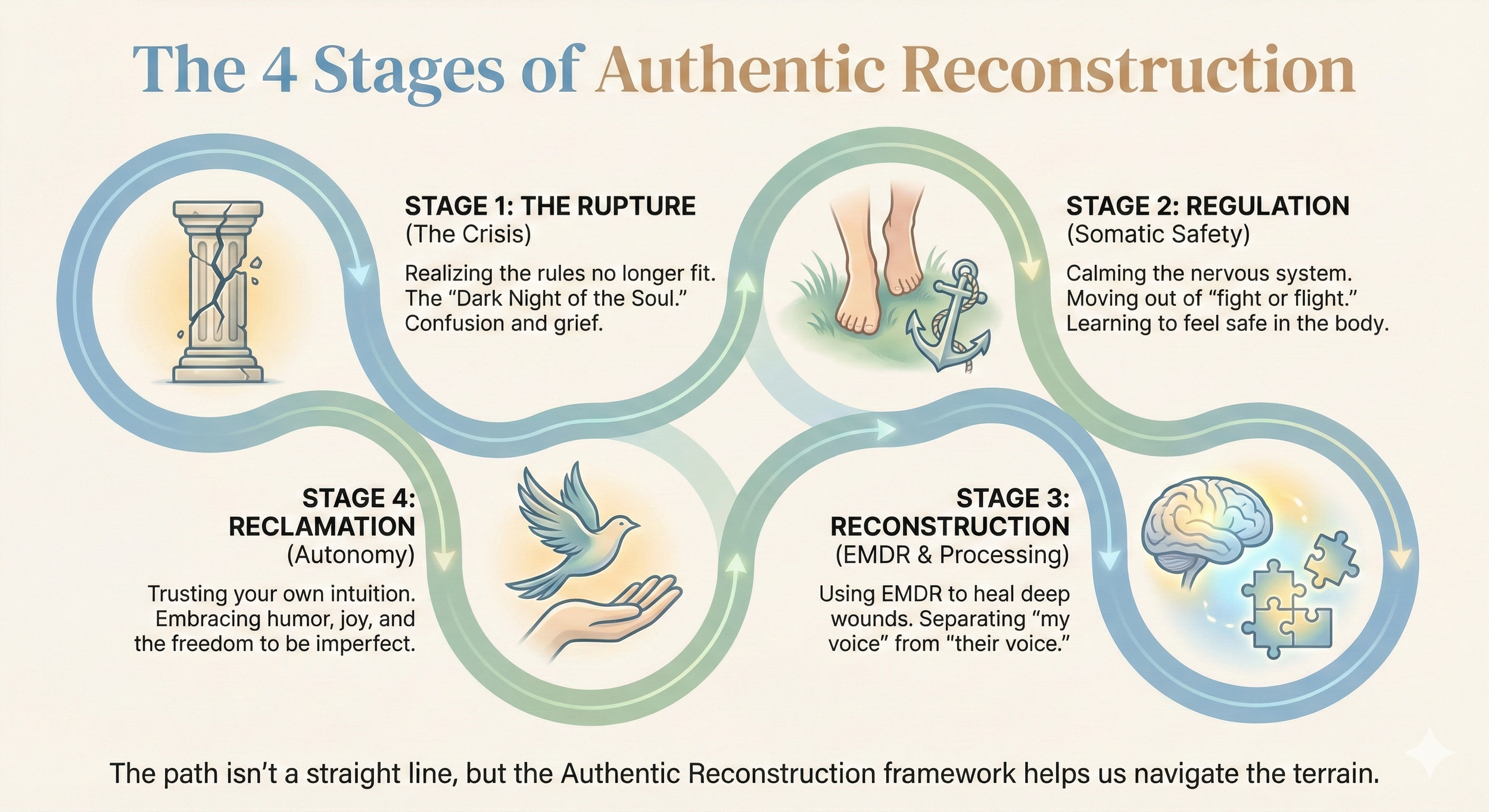
The 4 stages of Authentic Reconstruction
Why Work With Marsha Lowes?
There are many wonderful therapists in Texas. But if you are dealing with religious trauma, you need someone who understands the nuance of High-Control Groups (HCGs).
You don't need a therapist who will just tell you to "think positive." You need a human being who can sit with you in the complexity of grief, anger, and liberation. I am here to help you move from dogma to autonomy—not by giving you a new set of rules, but by helping you trust your own voice.
Ready to Reclaim Your Story?
You don't have to figure out the mysteries of the universe today. You just have to figure out how to be safe in your own skin. Contact me here.
