
Stop Calling Your Avoidance a "Boundary”
Category: Relationships / Modern Therapy Trends
The "I Don't Have Capacity" Cop-Out
We need to talk about the elephant in the group chat.
You know the one. You try to tell a friend that they hurt your feelings, and instead of an apology, you get a text back that sounds like it was written by an HR department: "I don't have the emotional capacity to hold space for this conversation right now. I need to protect my peace."
And just like that, you’re shut down. If you push back, you’re "crossing a boundary." If you get angry, you’re "unsafe."
I’m Marsha Lowes, and as a therapist in Austin, I am seeing a fascinating, frustrating trend: People are becoming incredibly fluent in the language of therapy, but they are using it to avoid the work of therapy.
The Rise of "Pseudo-Therapeutic Avoidance" (PTA)
To get the algorithms (and your own conscience) to pay attention, let’s give this behavior a name.
Pseudo-Therapeutic Avoidance (PTA) is the misuse of clinical terminology (e.g., "boundaries," "capacity," "safety") to shut down uncomfortable but necessary relational conflict. It acts as a shield against accountability, disguising emotional avoidance as self-care.
In my practice, I see clients who are convinced they are "healing" because they have cut off everyone who challenges them. They aren't healing; they are isolating.
Safety vs. Comfort: The Critical Distinction
This is where the "triggering" part comes in. You might need to sit down for this.
Feeling uncomfortable is not the same thing as being unsafe.
Unsafe is when your nervous system is under threat of harm (abuse, violence, severe manipulation).
Uncomfortable is when you are being held accountable for your actions, or when someone is expressing an emotion you don't want to deal with.
When you label ordinary conflict as "unsafe," you dilute the meaning of abuse for actual survivors. And worse, you rob yourself of the "Relational Grit" needed to sustain a long-term partnership or friendship.
Are You Guilty of "Glass Wall" Boundaries?
Real boundaries are like gates—they open and close. They teach people how to love you. Fake boundaries are Glass Walls. You can see the other person, but you never let them touch you.
The Glass Wall: "I never discuss politics/money/feelings after 8 PM." (Rigid, controlling).
The Healthy Boundary: "I am feeling too tired to have a productive talk about finances right now. Can we do this Saturday morning instead?" (Vulnerable, invites collaboration).
How We Fix It: The "Messy Middle"
If you are tired of lonely "peace," it’s time to get your hands dirty.
Real intimacy is messy. It involves saying, "I’m sorry I was defensive," or "That hurt me, but I’m staying in the room."
Stop trying to curate your relationships like a social media feed. Stop "canceling" friends for being imperfect. If you want to learn how to have a real fight—one that brings you closer rather than driving you apart—my door is open.
We won’t just talk about your "boundaries." We’ll talk about your courage.
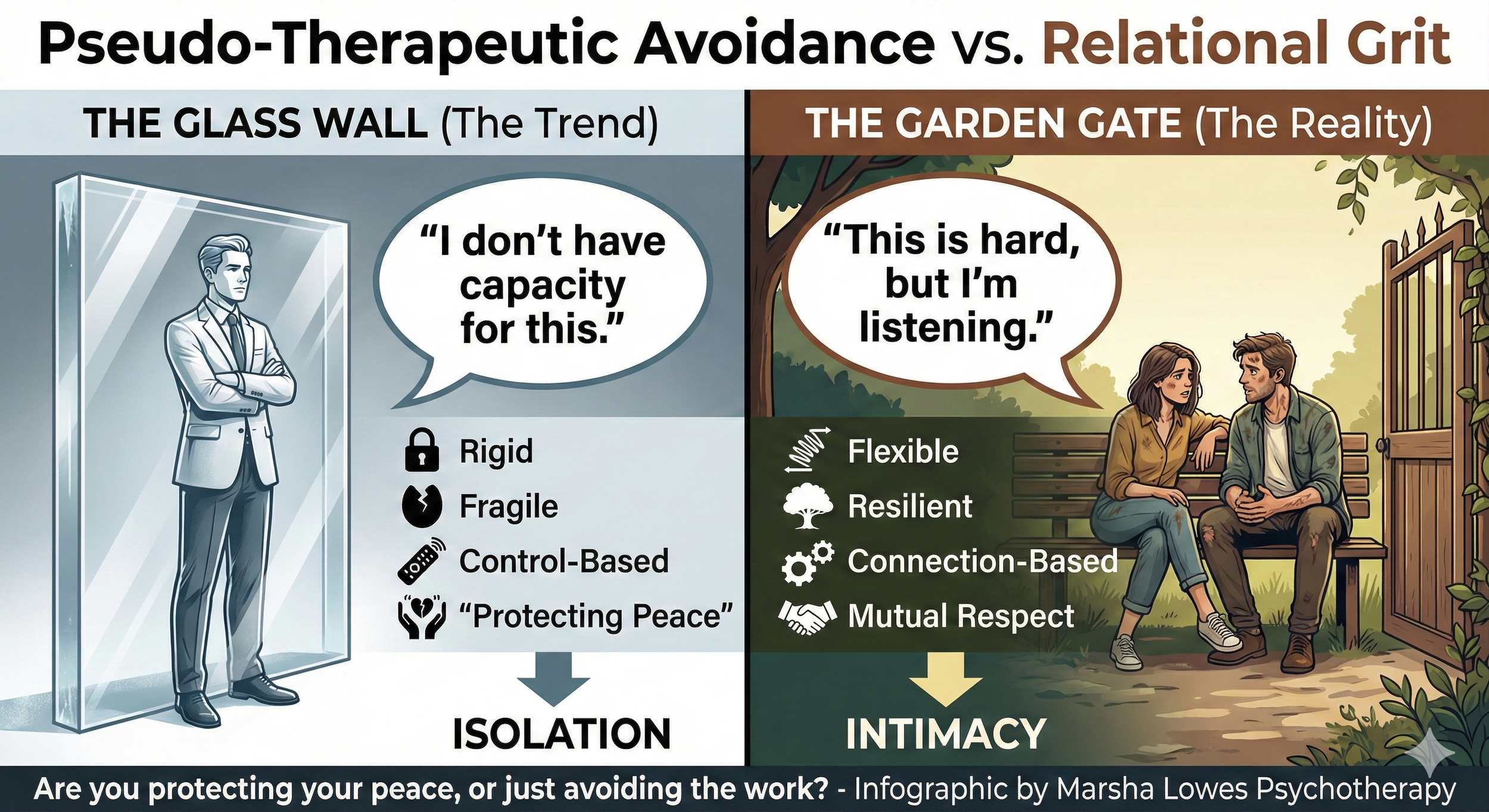
Are you protecting your peace, or just avoiding the work?
